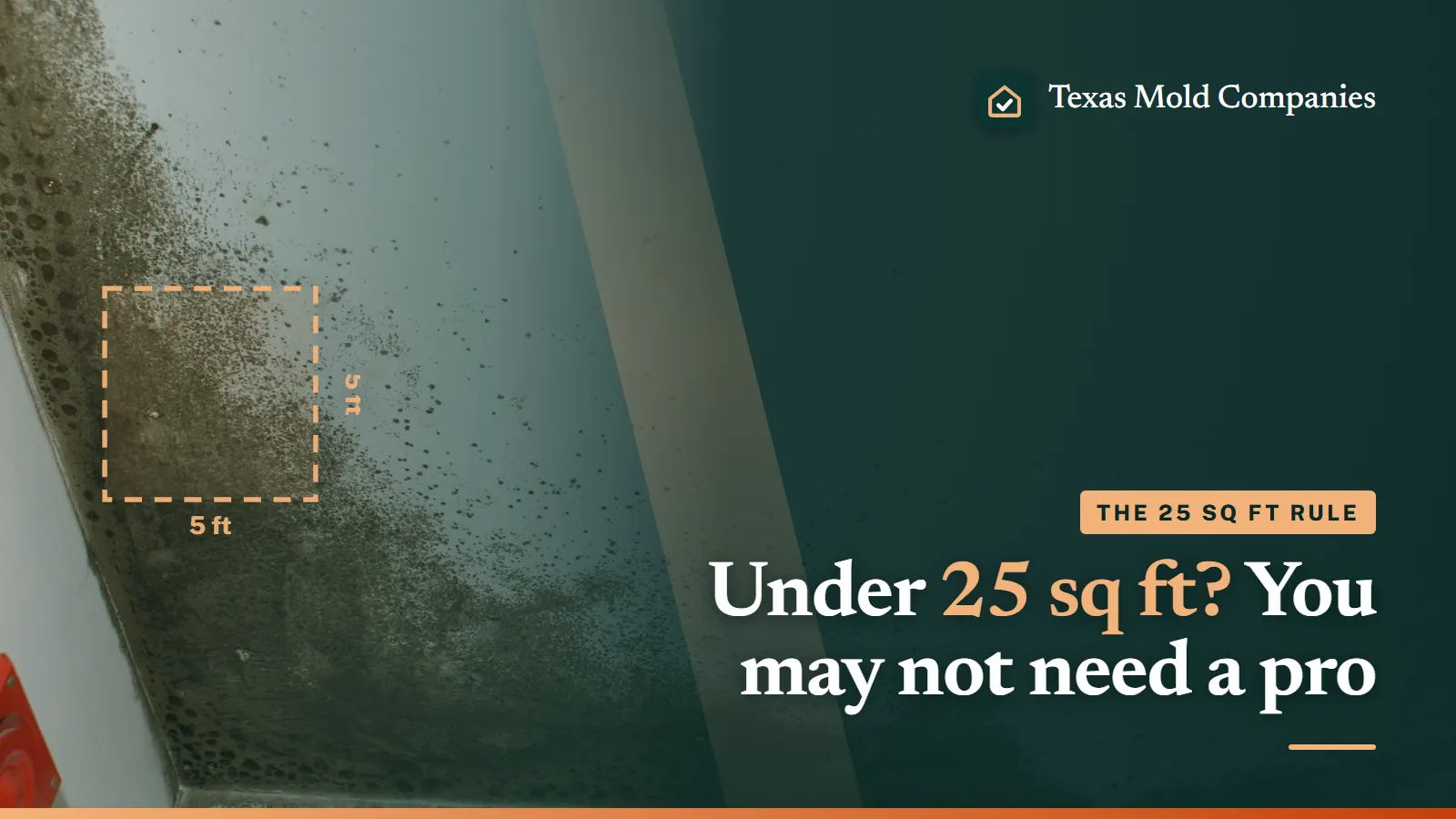
If you’re hiring someone to remove mold in Texas, one number decides whether they need a state license: 25 contiguous square feet. Under that, the law doesn’t require one. At or over it, a company you hire to remove it generally needs a Texas mold remediation license.
The hard part is knowing which side of the line you’re on. Here’s how to tell.
What the law says
“A person is not required to be licensed under this chapter to perform mold remediation in an area in which the mold contamination affects a total surface area for the project of less than 25 contiguous square feet.”
Read it the other way around: once the mold contamination for the project covers 25 contiguous square feet or more, that exemption no longer applies. The general rule in the same chapter takes over — a person may not do mold remediation for you without a mold remediation license (Texas Occupations Code §1958.101).
Three words that matter
- Contiguous means one continuous area. Picture a single patch, not separate spots added together.
- Total surface area is the statute’s phrase. Measure the whole affected surface, not only the part you can see from one spot.
- For the project ties the measurement to the job as a whole.
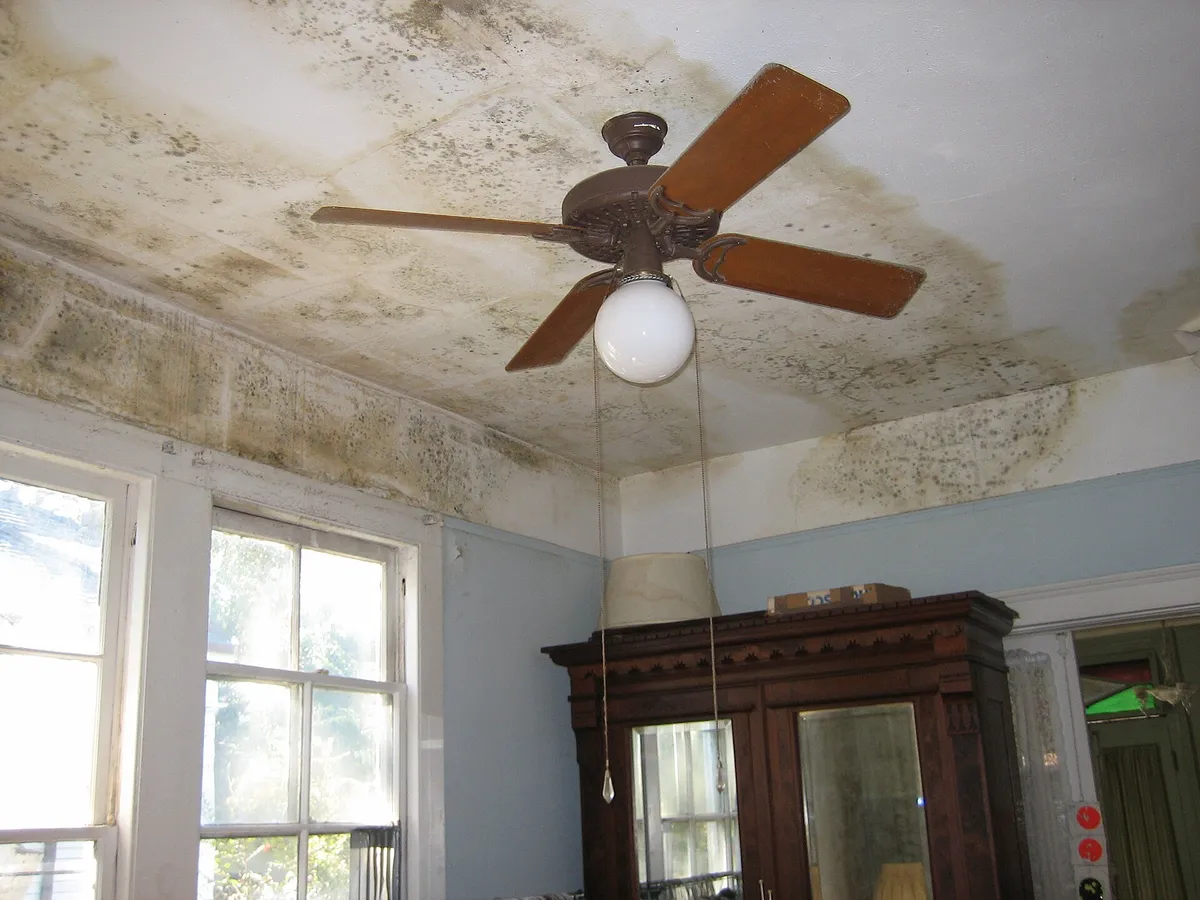
For scale, 25 square feet is a patch about 5 feet by 5 feet.
When you can’t tell how big it is
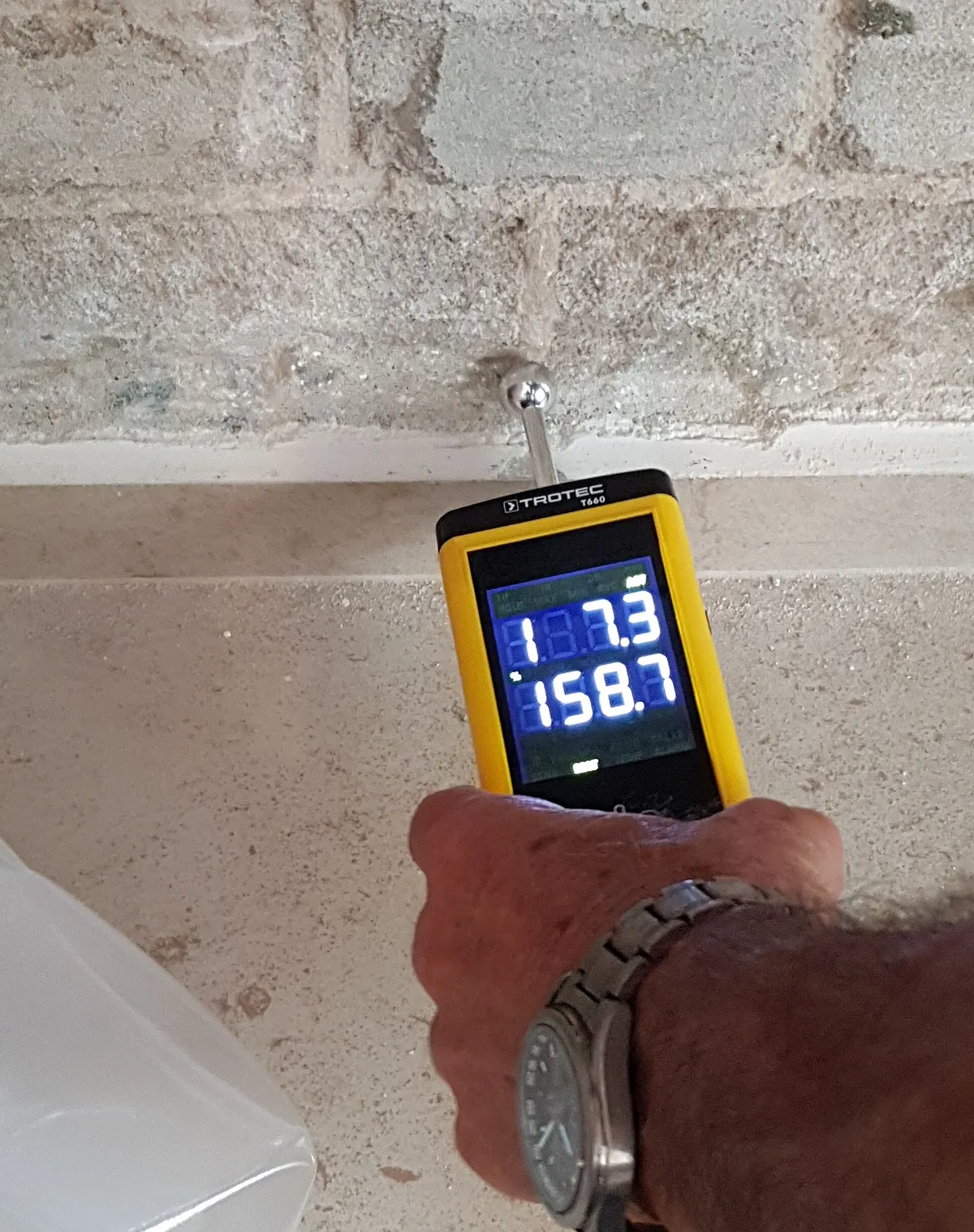
Most people find mold through a smell or a small visible spot. What you can see isn’t always the whole area. If you don’t know how far it goes, you don’t yet know which side of the line you’re on — and that’s exactly what a mold assessment is for.
A licensed mold assessment company (an inspector) evaluates whether mold is present and to what extent, according to the state’s Consumer Mold Information Sheet. In Texas the inspector can’t also do the cleanup on the same project, so their measurement isn’t tied to selling you the work. More on why that matters.
Where reviewers found mold
From our own analysis of Google reviews of Texas mold companies, these are the parts of the home that came up most:
- HVAC & ducts153
- Bathroom91
- Whole house82
- Walls & drywall70
- Kitchen63
- Attic30
- Crawlspace19
- Ceiling18
A review can mention more than one place. Counts are reviews, summed across 253 companies.
HVAC systems and ducts came up most often, followed by bathrooms and whole-house problems.
Several of those — ducts, wall cavities, attics — are places you can’t see into from the doorway, which is one more reason a measurement beats a guess.
Doing it yourself
Texas law doesn’t require a homeowner to be licensed to clean up mold in their own home. The owner exemption covers residential property the owner holds with fewer than 10 dwelling units (TDLR mold FAQ, and §1958.102(e) of the same chapter).
Under 25 square feet: no license required — but you still choose who does it
Below the line, Texas doesn’t require a license for the remediation. You can still hire a licensed company if you prefer. If you do, TDLR’s FAQ says the company doesn’t get to skip the rules because the job is small: a licensed remediator must still follow the law and rules, including a work plan that follows a protocol from a licensed mold assessment consultant.
On every company profile we show the Texas license number and expiry date, with a link to check it on the state’s own site.
At 25 square feet or more
Here’s one large professional job on film, so you know what to expect when a crew arrives.
Worth watching: a crew seals off the work area with plastic, runs HEPA-filtered negative air and wears respirators before tearing out a mold-covered basement floor.
Use a licensed mold remediation company. When the job is done, the law entitles you to a certificate of mold remediation:
“Not later than the 10th day after the date on which a license holder completes mold remediation at a property, the license holder shall provide a certificate of mold remediation to the property owner.”
See Texas mold law for what else the certificate covers.
Find licensed companies near you
We list companies with a current Texas mold remediation license, with their license numbers and what Google reviewers say about their mold work — for example licensed mold remediation in Houston and remediation companies across Dallas and Fort Worth. Austin and San Antonio have their own pages too, as do mold remediation companies based around Fort Worth and the licensed mold companies in El Paso.
This guide explains the law in plain English and isn’t legal advice.
Sources
- Texas Occupations Code, Chapter 1958 (Mold Assessors and Remediators) (opens in a new tab) — §1958.101, §1958.102(c) and (e), §1958.154
- TDLR — Mold Assessors and Remediators: Frequently Asked Questions (opens in a new tab) — Minimum Area Exemption; homeowner exemption
- TDLR — Consumer Mold Information Sheet (PDF) (opens in a new tab)
- U.S. EPA — A Brief Guide to Mold, Moisture and Your Home (opens in a new tab)