Mold is stressful, and that makes it easy to sign with whoever arrives first. A few checks — each one based on Texas law or the state’s own consumer guidance — take minutes and can save you a bad job.
Here are five warning signs, and what to ask instead.
1. One company offers to test and then fix the same mold
“A license holder may not perform both mold assessment and mold remediation on the same project.”
If a company inspects your home and then quotes to remove what it found on the same project, ask which license covers each part — and get the assessment from someone independent.
A 2013 ABC News report filmed exactly this: inspectors finding problems in a house that the program’s own experts said had no mold problem, then proposing expensive work.
Worth watching: it shows what an inspection that doubles as a sales pitch can look like. It was filmed in New Jersey in 2013, not Texas — which is exactly why Texas law’s split between inspector and remediator matters.
2. No license number
Every company we profile shows its Texas license number. You can check any license on the TDLR license search, and the state says a licensed individual must carry a current TDLR license certificate showing the number.
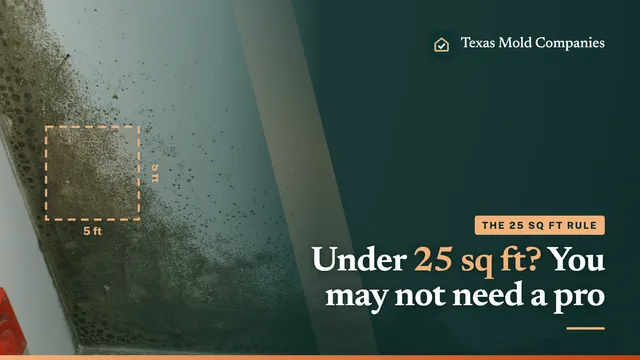
If a company can’t give you a number for a job of 25 contiguous square feet or more, that matters.
3. No information sheet before work starts
State rules require licensed mold assessors and remediators to give each client a copy of TDLR’s Consumer Mold Information Sheet before they start any mold assessment or remediation work. If work begins and you’ve never seen it, ask why.
4. No proof of liability insurance
The same sheet says the rules require licensees to carry commercial general liability insurance, or to be self-insured, to cover damage to your property — and it tells you to ask for proof of that coverage before hiring anyone.
5. No certificate after the job
The remediator must give you a certificate of mold remediation within 10 days. The exact wording.
What reviewers complain about
Serious complaints are rarer than you might expect. Across the 253 companies we profile, only 4 carry a watch-out from their Google reviews about mold work, and every one of them is for poor communication. A watch-out only shows when at least 3 reviews, and at least 10% of that company’s mold reviews, raise the same issue. How we decide what shows.
This guide explains the law in plain English and isn’t legal advice.
Sources
- Texas Occupations Code, Chapter 1958 (Mold Assessors and Remediators) (opens in a new tab) — §1958.154, §1958.155
- TDLR — Consumer Mold Information Sheet (PDF) (opens in a new tab) — information sheet, license certificate, liability insurance, complaints
- TDLR — License search (opens in a new tab)